
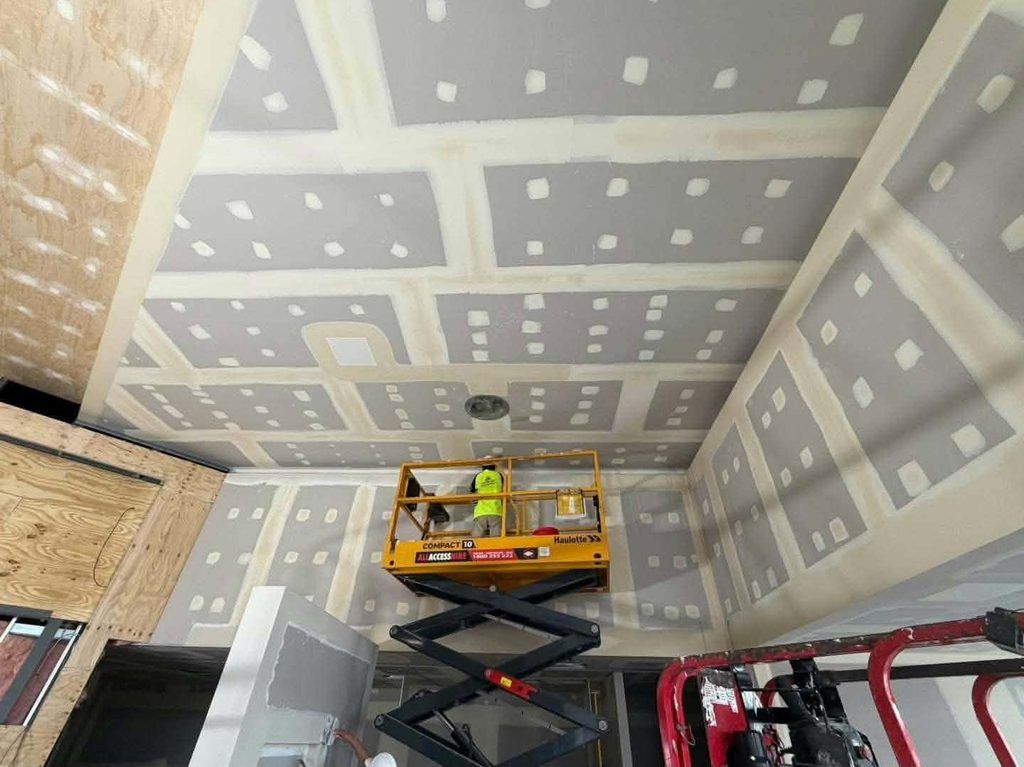
Why installed sheets are only the starting point
Plasterboard sheets create the lining, but their joins, fasteners and corners still need finishing. Setting treats these areas so they form part of a consistent surface rather than standing out as separate elements. Sanding then refines the finished compound where required; it cannot substitute for properly supported sheets or suitable joint treatment.
For a Bardon renovation, understanding this distinction helps explain why “the board is up” and “the room is ready for the painter” are different milestones. A realistic programme includes the finishing work, not just installation day.
Treat joints and junctions as different details
Sheet joints, external corners and wall-to-ceiling junctions do not all use the same detail. The appropriate treatment depends on the lining and the specified finish. A plasterer should assess what is being finished and use compatible products and methods rather than treating every visible gap as a filling task.
Renovation tie-ins add another consideration. New compound may meet an existing painted surface or an older repair. The surrounding material needs assessment and preparation so that the new work is not relying on an unsuitable surface. Ask whether these tie-ins are included in the setting scope.
Allow the products their required drying stages
Different compounds have different setting or drying requirements. Conditions in the room and the thickness of application can affect the sequence. A fixed promise that every job can be finished and painted immediately is not a useful basis for planning.
Instead, ask which stages are included and when the next trade can proceed. If the renovation is in an occupied room, coordinate access and protection across those stages. It is better to allow the process the time it needs than to hide incomplete work beneath paint.
Consider the light that will reveal the surface
Strong light passing across a wall can make irregularities more noticeable. Window placement, wall lights and the intended paint finish should therefore be discussed before choosing the expected finish. A small sample viewed in one light may not represent a large wall under another.
Sanding is not a cure for an uneven substrate or every alignment problem. Excessive sanding can also damage surfaces. The practical goal is the agreed finish using the appropriate system, not an unsupported promise that no irregularity will ever be visible under any lighting.
Clarify the painter's starting point
Plastering and painting are related but separate scopes. Confirm who checks the surface at handover, who performs painting preparation and which primer and coatings are required. This avoids treating “ready for paint” as a vague phrase with a different meaning for each trade.
Brisbane Plastering offers plasterboard installation and finishing, alongside renovation plastering. If your Bardon project also changes the ceiling junction, discuss the square-set detail. Request a quote with the room's lighting, lining condition and finishing requirements. The illustrative photograph shows joint finishing in progress; its suburb is not established.